


Generic AI Review Responses Are the New Invisible: Why LLMs Reward Hotels That Sound Like Themselves

Reputation Management
All Your Reviews In One Place
Track Reviews & Feedback, Collect More Reviews, Prevent Poor Reviews, Guest Feedback, Analytics & Reporting, Respond to Reviews with guestAI or with our Dedicated Team, Reviews Widget for Website, PMS Automations and more.
Book a Quick 15-minute Call for a Customized Setup. We personalize your trial by understanding your brand's unique goals during a quick call.
Guest Messaging Platform
Transform Guest Communication & Revenue with an All-in-One Platform
Seamless Guest Communication and Engagement: From Pre-arrival to Check-out
Book a Quick 15-minute Call for a Customized Setup. We personalize your trial by understanding your brand's unique goals during a quick call.
Review Responses
Done For You
Handcrafted, Personalized Responses to Your Online Reviews. Done for You.
Book a Quick 15-minute Call for a Customized Setup. We personalize your trial by understanding your brand's unique goals during a quick call.
Request Free Trial
Book a Quick 15-minute call
We personalize your trial by understanding your brand's unique goals during a quick call.
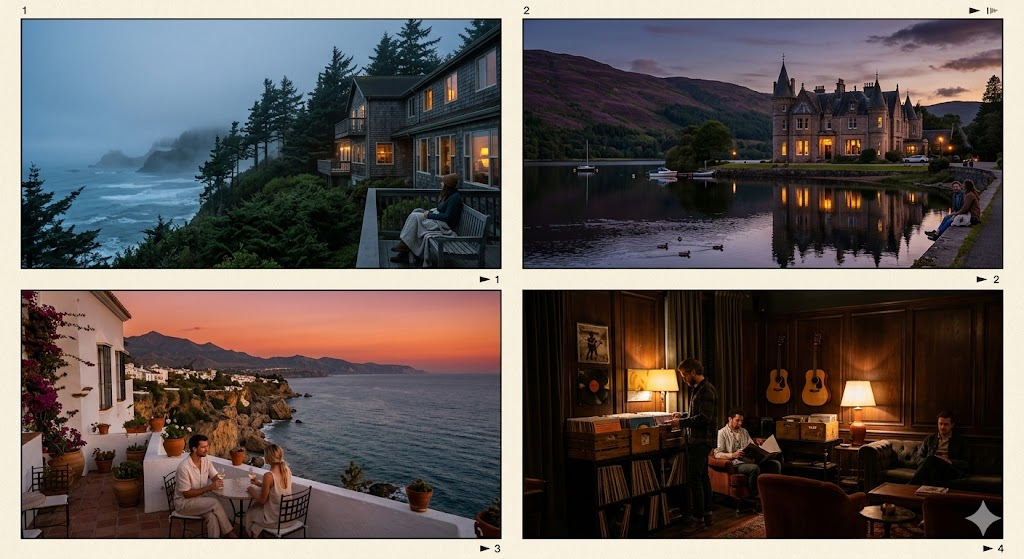
There is a 120-room hotel on the Oregon coast that smells like cedar and old books. The owner knows every trail within ten miles. She hand-writes a note for every guest who mentions it is their first time seeing the Pacific.
There is a 340-room country house hotel in the Scottish Highlands where the head of guest relations knows which guests are celebrating anniversaries before they arrive, and where the loch-side suite has been requested by the same family every August for fourteen years.
There is a 68-room parador on the Andalusian coast of Spain, built around a sixteenth-century convent, where the head chef sources from the same three fishing families his grandfather used, and the terrace at dusk is something guests describe in reviews as one of the most beautiful things they have ever seen.
There is a 55-room boutique hotel in Nashville where every room is named after a different era of country music, the staff greets guests by name before they reach the front desk, and the complimentary vinyl collection is genuinely curated.
None of these properties sound the same. None of them should respond to reviews the same way. And yet, when review responses are generated without any real understanding of a property — its story, its staff, its location, its guests, its particular kind of magic — that is exactly what happens. Smooth. Professional. Completely interchangeable. The kind of response that could have come from any of the 700,000 hotels on Booking.com.
A review response is not just reputation management. It is a public expression of what your hotel believes about hospitality. When it sounds generic, that belief disappears — for the guest reading it, and increasingly, for the AI systems deciding whether to recommend you at all.
Your Hotel Is Not a Template. Your Responses Should Not Be Either.
Every property that joins GuestTouch goes through an onboarding process that most reputation tools skip entirely. We ask the questions that cannot be answered by a tone-of-voice dropdown:
- What do guests mention that surprises them? The thing they did not expect and loved.
- Which staff members do guests name in reviews, and what specifically do they do to earn that? Not “great service” — the actual behaviour.
- What is the one complaint you receive that stings because you know it is fair? And how do you want to address it honestly without sounding defensive?
- What local knowledge only your team has? The restaurant not on any app. The walk nobody else recommends. The time to avoid the car park. The fishing spot only the concierge knows about.
- What are the geographic anchors and local magnets for your property? The landmarks, institutions, and districts that bring guests through your door.
- What should a response never promise or say in a particular way? The phrases that have caused problems. The commitments your team cannot always honour.
This is the knowledge base that trains guestAI and guides the managed team. It is not a brand voice prompt. It is a genuine understanding of your property, the 120-room coastal hotel and the 340-room country house and the 68-room parador and the 55-room Nashville boutique — as the specific, irreplaceable place it actually is.
The responses that come out of that process cannot be replicated by any other hotel’s tool. They are built from the ground up around what makes your property yours.
‘Brand Voice’ Is Not Enough. You Need Brand Trust & Authenticity
The hospitality technology industry has converged on “brand voice” as the answer to generic AI responses. Train the AI on your tone. Tell it whether you are warm and approachable or elegant and refined. The AI will match the style.
But what it actually needs to deliver is brand trust and authenticity — something far deeper than tone.
Your hotel is not a style. It is a living organism with a specific location, a specific history, a specific cast of characters who show up every morning, and a specific set of things guests experience that they cannot find anywhere else. Whether you are a 55-room boutique or a 340-room country house, that specificity is what separates you.
Brand voice tells AI how to write. It does not tell AI what your hotel actually is. And — critically — it does not give the system the property-specific detail that makes a response valuable to both the reader and the algorithm.
The difference shows up clearly when you put two responses side by side.
A guest at a small coastal hotel leaves this review:
“Woke up to fog and the sound of seals. Maria at the front desk had already left a note with the best trail for low-tide tide pools. The chowder at the restaurant next door — she recommended it — was the best thing I ate all trip. Came for one night, stayed three.”
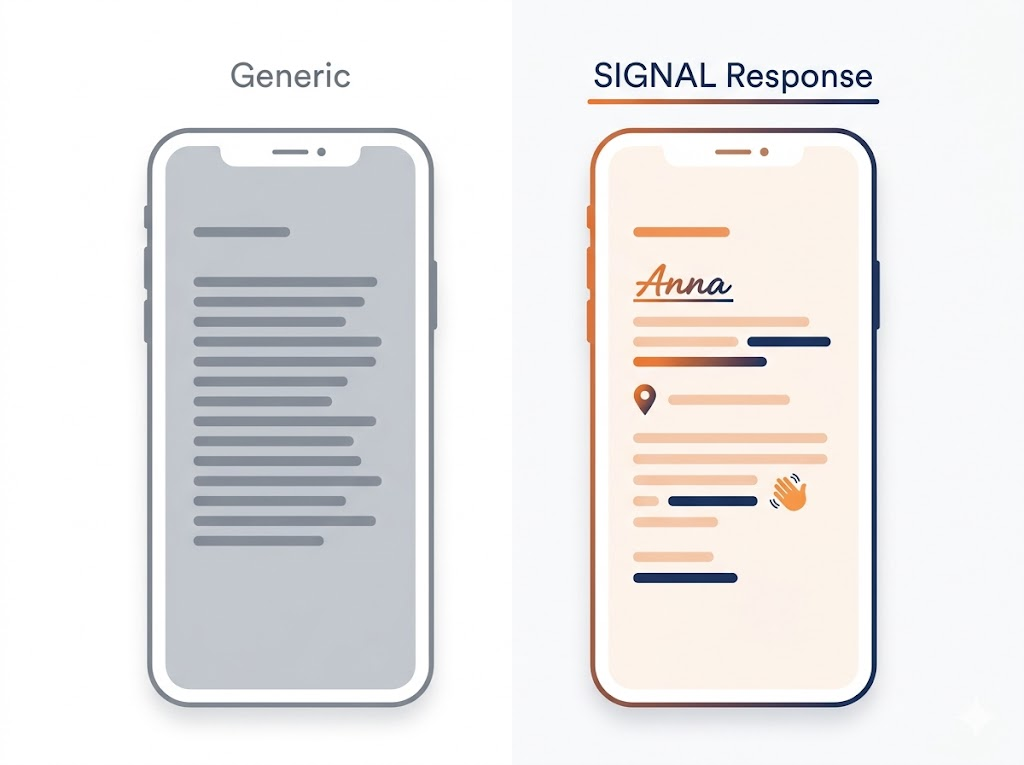
✕ GENERIC AI RESPONSE
Thank you so much for your wonderful review! We are thrilled to hear that you enjoyed your stay with us and that our team was able to make your experience special. It means a lot to know that our staff went above and beyond to ensure your comfort. We hope to welcome you back again soon!
✓ GUESTTOUCH-POWERED RESPONSE
Fog and seals — that is honestly one of our favourite kinds of mornings here on the Pacific. Maria will be so glad to hear this; she has been recommending that tide-pool trail since her first week with us, and it is still the walk most guests talk about long after they leave. The fact that the chowder made your trip makes us feel like we did something right. One night turning into three is the best thing a guest can tell us. Come back in summer — the seals bring their pups, and the trail looks completely different at high tide.
Both responses are polite. Both are correct. Only one sounds like it came from a place that actually exists — and only one gives the AI systems indexing this page something specific and citable to work with.
LLM Systems Are Reading Your Responses. Here Is What They Are Looking For.
Most hoteliers think of a review response as a communication to the guest who wrote it, and to future guests who might read it. Both of those audiences still matter. But there is now a third audience that has entered the picture quietly and carries significant weight: the LLM/AI systems and large language models that determine whether your property appears in travel recommendations at all.
When a traveller asks ChatGPT, Google’s AI Mode, or Perplexity to recommend a boutique hotel near the Teton range, or a country house hotel in Scotland, or a business hotel within walking distance of the convention centre — those systems are not just reading your star ratings. They are reading the full text of your reviews, and the full text of your responses to them.
Research tracking AI Overview citations in travel found that 79% of hotel links surface from Google Business Profiles, not hotel websites. Google reviews are described by senior digital marketing practitioners as “the most consistent signal being displayed” in AI Mode. Your management responses are part of that signal — and they are being read and weighted, not skimmed.
What LLM systems are evaluating in your responses goes well beyond whether you said thank you. They are reading for:
- Operational responsiveness. A hotel that responds to reviews within 48 hours signals that a real, attentive operator is behind the listing. Slow or absent responses read as passivity — to guests and to algorithms alike.
- Contextual authenticity. Responses that reflect specific details of the guest’s stay — staff names, exact amenities, local references — register as genuine. Generic thank-you notes do not carry the same semantic weight.
- Accountability signals. Responses to negative reviews that acknowledge issues and explain resolutions signal a service-oriented operator. Defensive or templated responses do not.
- Geographic and entity richness. Responses that naturally name landmarks, neighbourhoods, local institutions, and property-specific attributes give AI systems the structured data they use to match your property to relevant searches.
- Recency. Frequent, recent responses signal an active, operational property. AI systems weight freshness.
The conclusion is direct: a hotel with 200 reviews and no owner responses looks less trustworthy to both algorithms and guests than one with 80 reviews and thoughtful, specific replies. Quality of response has entered the algorithm. This is no longer a nice-to-have, it is a visibility decision.
This is also why GuestTouch developed the SIGNAL framework — six categories of property-specific knowledge (Signature Experience, Intent & Purpose, Geographic Anchors, Neighborhood Vibes, Authority Proof, and Local Magnets) that guestAI draws on to make every response semantically rich for both guests and algorithms. Every property’s SIGNAL profile is built during onboarding and refined over time, ensuring that what the algorithm reads reflects what actually makes your hotel worth recommending.
The Operational Reality: Not Just Doing the Task — Doing It the Best Possible Way
Here is what the conversation about AI review responses usually misses: the problem most hotels have is not that they do not know how to write a good response. It is that they cannot do it well, consistently, at scale, without it becoming a significant operational burden.
The general manager of a 120-room coastal hotel is also helping at front desk, managing housekeeping, handling supplier relationships, and fixing the thing that broke this morning. The guest relations director at a 340-room country house is managing a team, coordinating with F&B and spa on guest feedback, and preparing a weekly report for ownership. Neither of them has the bandwidth to treat every review response as a standalone creative project — even when they know exactly what a great response looks like.
This is the operational gap that technology needs to close. Not just “AI writes the response” — that is a feature, not a solution.
The real measure is not whether the response got written and posted. It is whether the response is as good as it would have been if your best person had unlimited time, full context on the guest, and deep knowledge of your property at their fingertips. That is the standard GuestTouch is built around. Not the task done. The task done the best possible way.
GuestTouch is designed as an adaptive layer, not always a replacement system. Whether you are a single-property owner or a multi-property group, the platform bends to your workflow — optimising what works, filling what is missing, and never requiring you to abdicate oversight to get the efficiency gains.
That adaptability is what makes the Response Control Spectrum meaningful in practice. It is not three pricing tiers with different feature sets. It is three genuinely different operating models — each designed around how a specific type of hotel actually functions.
The Response Control Spectrum
The right approach to review responses depends on your team’s capacity, your review volume, and how much direct oversight you want to maintain. GuestTouch is built around three modes — not a ladder, but a genuine spectrum of operating models that you can move between as your needs change.
MODE 1 GuestAI-Assisted
Your brand trust and authenticity, in every response — built for how AI systems read you.
In this mode, your staff owns every response. guestAI generates a personalised draft for each incoming review — drawing on your property’s SIGNAL knowledge base: the specific staff, amenities, local references, and guest intent patterns that make your property distinctive. Your team reads the draft, edits what they want, and posts it. Nothing goes live without a human decision.
The AI eliminates the blank page problem and maintains consistency on your busiest days. Your team exercises judgment on every single review. Over time, guestAI’s output becomes indistinguishable from your best responder on their best day — because it is trained on exactly that.
MODE 2 Adaptive Smart Workflow
Intelligent delegation. Your team stays in the loop on what matters — not on everything.
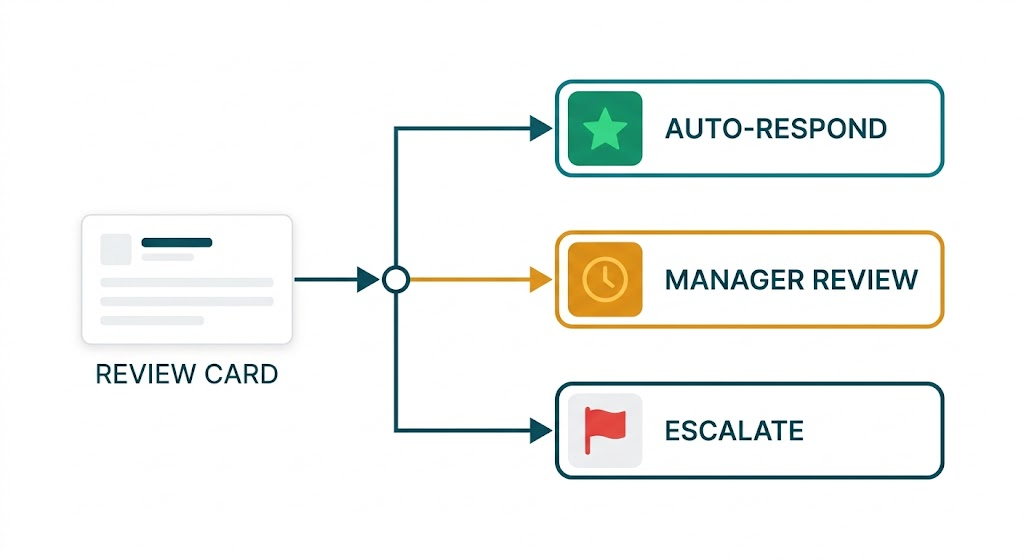
Adaptive Smart Workflow lets you set conditional rules that determine how each review is handled. You define the logic; the platform executes it. This is smart delegation, not abdication — and the rules adapt to your operation, not the other way around.
A typical configuration: 5-star reviews with no written text are responded to automatically using guestAI. 4-star reviews with substantive feedback are drafted and flagged for quick manager review within 24 hours. Anything rated 1, 2, or 3 stars routes to a human before a single word goes live. Reviews containing trigger phrases — “refund,” “misleading,” “never again” — escalate to the GM immediately regardless of star rating. Every rule is yours to configure and change.
Your team is not removed from the process. They are freed from the low-stakes portions of it so they can apply real attention where it actually matters. The AI handles the clear-cut. Your people handle the complex. That is efficiency without loss of control.
MODE 3 Fully Managed
A dedicated expert team responds on your behalf. Your voice, their expertise, full SIGNAL coverage.
Some hotels do not have the internal capacity to manage review responses consistently — even with excellent tools available. The general manager is also the front desk, the maintenance coordinator, and the person who just dealt with a difficult check-out. Fully Managed exists for exactly this reality.
A dedicated team of hospitality-trained response specialists learns your property in genuine depth — your story, your staff, your location, your signature moments, your sensitive topics, and how you talk about the things you are still working on. They write responses using the full SIGNAL framework, producing replies that sound like they came from someone who has walked your halls — because in every meaningful sense, they have.
Adaptive Smart Workflow is embedded into the managed service. Your GuestTouch team uses the same conditional logic — routing sensitive reviews for internal discussion before responding, flagging emerging sentiment patterns, and delivering a regular digest rather than a daily stream of notifications. You maintain full oversight; you just do not have to be in the queue.
The Response That Earns the Next Booking — and the Next Recommendation
The Oregon coast hotel. The Scottish Highlands country house. The Andalusian parador. The Nashville boutique. None of them should respond the same way. None of them do — when the system is built right.
The goal of review management is not to clear a queue. It is to make the person reading the response feel something: confidence that the hotel is worth booking, recognition that someone actually read what they wrote, trust that the people running the place care about more than the star rating. And increasingly, it is to give the AI systems shaping travel discovery the specific, citable, property-rich signals they need to put your hotel in front of the right traveller at the right moment.
Generic responses fail both audiences. Responses built on deep property knowledge, delivered through the right operating model for your team, serve both.
That is what GuestTouch is built to do.
Want to see what your hotel’s responses could look like — and how your property’s SIGNAL profile would be built? Book a 20-minute conversation with the GuestTouch team. We’ll walk through your current review workflow, show you where the gaps are, and demonstrate what guestAI produces with your actual property knowledge.
Explore GuestTouch Reputation Management and Managed Responses: guesttouch.com/reputation-management
More questions? Book a quick 15-minute call with GuestTouch — we'll walk you through a setup personalized to your property.


Need Help ?
Talk to our Experts to supercharge your Pre-Arrival experience
Schedule Now
Posted on
June 9, 2026
Referenced GuestTouch Products
AI generated responses for your reviews
Powered by Review Response AI

Get bright ideas and best practices delivered straight to your inbox
Stay up to date! Get all the latest & greatest posts delivered straight to your inbox
Don’t worry we won’t send you spam